Ok, it's not that I hate English, I am just having trouble speaking it, which makes me frustrated. It's the little things, like verb tenses (past perfect), irregular verbs (too embarrassing to give an example), and specific words people don't often use (orthopedic).
And then, expressing myself is really hard. I have about 50 things I want to say, and I can't get my thoughts in order to make an intelligent sentence. I'm not necessarily thinking in Chinese. I'm not really thinking in any language. I have ideas in my mind that I haven't put in English yet- I learned not to think in English because I'd have to translate it to Chinese. Instead, I would take my thoughts, ideas, and concepts, and just say them as best as I could in Chinese.
My family can put up with me, but I hope I don't sound like an idiot when I go back to school.
Showing posts with label English language. Show all posts
Showing posts with label English language. Show all posts
09 January 2010


06 August 2009
Phonetics
I taught a woman how to read today. She has been in the beginning English class all summer, and I just started working with her this week. I realized immediately that she could not read, but for a few days we just worked through the class material verbally. She copied from the board without understanding what she was writing, and she repeated sentences after me not knowing what she was saying.
But today, we started at square one. I showed her how to hold a pencil. Then I wrote a capital A and made her write it correctly (I’m really into writing properly after having to write Chinese characters in proper stroke order; it really does matter!).
Then, I did a major throwback to when I was about three years old and would sit on my mom’s lap and do Hooked on Phonics every evening (Thank you, Mom!). Over and over, I had my student repeat “A, ah, apple; B, buh, ball; C, ck, cat, etc.” We went through the whole alphabet, learning to write, learning the names of the letters, learning the sounds each letter makes, and learning new words, too.
Next, I used a random worksheet the student had from class. It happened to be a lesson about health. I circled a word. First she said each letter: S-I-C-K. Then she slowly made the sound of each letter. Next, she put it all together.
She learned to read!
I had her read several words, and after each one she squeezed my hand and thanked me. After class, she gave me a big hug and kissed me on the cheek. Teaching her took a lot of patience. But she was so attentive and persistent. I’ve never seen anyone so happy before. I was pretty happy, too.
But today, we started at square one. I showed her how to hold a pencil. Then I wrote a capital A and made her write it correctly (I’m really into writing properly after having to write Chinese characters in proper stroke order; it really does matter!).
Then, I did a major throwback to when I was about three years old and would sit on my mom’s lap and do Hooked on Phonics every evening (Thank you, Mom!). Over and over, I had my student repeat “A, ah, apple; B, buh, ball; C, ck, cat, etc.” We went through the whole alphabet, learning to write, learning the names of the letters, learning the sounds each letter makes, and learning new words, too.
Next, I used a random worksheet the student had from class. It happened to be a lesson about health. I circled a word. First she said each letter: S-I-C-K. Then she slowly made the sound of each letter. Next, she put it all together.
She learned to read!
I had her read several words, and after each one she squeezed my hand and thanked me. After class, she gave me a big hug and kissed me on the cheek. Teaching her took a lot of patience. But she was so attentive and persistent. I’ve never seen anyone so happy before. I was pretty happy, too.
04 August 2009
Scandal in English Class
Last week in English class (see TESOL), we were discussing how to introduce oneself in English.
The main teacher began asking some of the students to introduce themselves to the class. A married couple from Africa introduced themselves together, and it was discovered that they were married when the wife was 14 and the husband was 26.
Scandal? That’s what the main teacher (from Russia) thought. This teacher stopped class and interrogated the 30 or so African students about their countries’ and cultures’ practices.
“You mean small girls – children of 14 - they marry grown men? They have babies? But they don’t know - they can’t think - they don’t understand what they’re doing!”
These African students can barely introduce themselves in English, but they gave a pretty fabulous rebuttal: “In America, 14 year old girls have babies and they’re not married. In Africa, the girls are married. In Africa, it’s better.”
It was also clarified that prearranged marriages and girls getting married in their early teens is not common any more. The aforementioned couple has been (happily) married for 25 years, and their situation would not likely occur today.
During this 15-minute discussion, I wasn’t really sure what to do. At first, I wanted to stop the teacher; rebuke her, really, for being insensitive to different cultures. Then, I wanted to try to help the African students defend themselves. I decided against both, and just watched, listened, and learned. After it was all over, there were no hard feelings. Class continued with a discussion of grammar, rather than have more students give introductions.
The main teacher began asking some of the students to introduce themselves to the class. A married couple from Africa introduced themselves together, and it was discovered that they were married when the wife was 14 and the husband was 26.
Scandal? That’s what the main teacher (from Russia) thought. This teacher stopped class and interrogated the 30 or so African students about their countries’ and cultures’ practices.
“You mean small girls – children of 14 - they marry grown men? They have babies? But they don’t know - they can’t think - they don’t understand what they’re doing!”
These African students can barely introduce themselves in English, but they gave a pretty fabulous rebuttal: “In America, 14 year old girls have babies and they’re not married. In Africa, the girls are married. In Africa, it’s better.”
It was also clarified that prearranged marriages and girls getting married in their early teens is not common any more. The aforementioned couple has been (happily) married for 25 years, and their situation would not likely occur today.
During this 15-minute discussion, I wasn’t really sure what to do. At first, I wanted to stop the teacher; rebuke her, really, for being insensitive to different cultures. Then, I wanted to try to help the African students defend themselves. I decided against both, and just watched, listened, and learned. After it was all over, there were no hard feelings. Class continued with a discussion of grammar, rather than have more students give introductions.
29 July 2009
TESOL
(Teaching English to Speakers of Other Languages)
This summer, I’ve been volunteering teaching English in Columbus. The free classes are offered four days a week at a community center. They are sponsored through a federal grant, and any adult who wants to learn English as a second language can attend.
Most of the students are from various countries in Africa: Sudan, Senegal, Guinea, Mauritania, and Ghana. (I had to study a map after my first day of class!) The students generally can speak their African languages and French – and I’ve become pretty decent at BS-ing my way through French.
Each class is two hours and is taught by a teacher employed by the community center. My job is to work one-on-one with the students who need extra help in the class.
Teaching is hard work. Not only do the students have no English skills, some of these adults are illiterate in their native languages. All of the students work hard; the class is free, and they wouldn’t be there if they didn’t want to come. But how do you explain English sentence structure to someone who doesn’t know what a verb is? How do you describe the difference between “we” and “they” if their language doesn’t distinguish between them the same way English does? How do you make them copy off the blackboard when they don’t know the alphabet? These are things I am learning how to teach. (It’s not impossible!)
Every day is a new challenge. But I’m learning a comprehensive method for teaching English. When I go back to China in September, I plan on offering free, elementary English courses. I taught English last time I was there, but I had no method… and I think I failed. But this time, I’m determined to succeed.
This summer, I’ve been volunteering teaching English in Columbus. The free classes are offered four days a week at a community center. They are sponsored through a federal grant, and any adult who wants to learn English as a second language can attend.
Most of the students are from various countries in Africa: Sudan, Senegal, Guinea, Mauritania, and Ghana. (I had to study a map after my first day of class!) The students generally can speak their African languages and French – and I’ve become pretty decent at BS-ing my way through French.
Each class is two hours and is taught by a teacher employed by the community center. My job is to work one-on-one with the students who need extra help in the class.
Teaching is hard work. Not only do the students have no English skills, some of these adults are illiterate in their native languages. All of the students work hard; the class is free, and they wouldn’t be there if they didn’t want to come. But how do you explain English sentence structure to someone who doesn’t know what a verb is? How do you describe the difference between “we” and “they” if their language doesn’t distinguish between them the same way English does? How do you make them copy off the blackboard when they don’t know the alphabet? These are things I am learning how to teach. (It’s not impossible!)
Every day is a new challenge. But I’m learning a comprehensive method for teaching English. When I go back to China in September, I plan on offering free, elementary English courses. I taught English last time I was there, but I had no method… and I think I failed. But this time, I’m determined to succeed.
11 August 2008
Beijing
The only word that I can think of to describe Beijing during the Olympics is: facade.
Honestly, my least favorite part of my entire trip to China was Beijing the past few days. I remember what it was like when I flew in in February, and almost everything was unrecognizable.
Small shops and street vendors had been closed down, and I wonder what those people do now for a living. Everyone was attempting to speak English and it was awkward. It was too crowded to see anything in the city. The city looked pristine and fake.
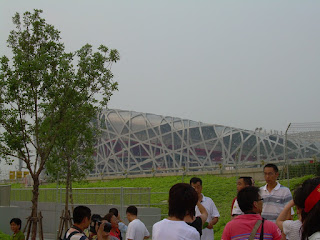
Also, the air was bad. I know they say they cleaned it up, and I believe they did. But I lived in Lanzhou, "one of the most polluted cities in China" for five months with no problems. In Beijing I had difficulty breathing and I coughed often. I still have my cough.

It was neat to be in Beijing during the Olympics. It was an exciting atmosphere. I got to see the cycling street race which was a great opportunity.
But I didn't get to talk to any locals, except friends that I already knew who live in Beijing, and I didn't get to experience what Beijing is actually like.
I prefer small Chinese cities to large ones.
Honestly, my least favorite part of my entire trip to China was Beijing the past few days. I remember what it was like when I flew in in February, and almost everything was unrecognizable.
Small shops and street vendors had been closed down, and I wonder what those people do now for a living. Everyone was attempting to speak English and it was awkward. It was too crowded to see anything in the city. The city looked pristine and fake.

Also, the air was bad. I know they say they cleaned it up, and I believe they did. But I lived in Lanzhou, "one of the most polluted cities in China" for five months with no problems. In Beijing I had difficulty breathing and I coughed often. I still have my cough.

It was neat to be in Beijing during the Olympics. It was an exciting atmosphere. I got to see the cycling street race which was a great opportunity.
But I didn't get to talk to any locals, except friends that I already knew who live in Beijing, and I didn't get to experience what Beijing is actually like.
I prefer small Chinese cities to large ones.
03 August 2008
The Dreaded Phrase
A few months ago, I learned a Chinese phrase that I really liked. It’s jia you and it’s used kind of like how we use “let’s go” or “go, fight, win.”
I like the phrase because of what it actually means. Jia means to add. You means oil. And the idea is “add oil to the fire.” Like… keep on going, keep on burning. Get it?
And, interestingly, the word for gas station is jia you zhan with zhan meaning a stop or a stand.
But because of the Olympics, I never stop hearing jia you. It’s getting exceptionally annoying. No one says anything else. In English, we have several phrases to convey this same idea. In Chinese, they only use one. And they use it often.
I don’t want to hear it again… so much so that I’m not proofreading this post because I can’t bear to even see the words again.
I like the phrase because of what it actually means. Jia means to add. You means oil. And the idea is “add oil to the fire.” Like… keep on going, keep on burning. Get it?
And, interestingly, the word for gas station is jia you zhan with zhan meaning a stop or a stand.
But because of the Olympics, I never stop hearing jia you. It’s getting exceptionally annoying. No one says anything else. In English, we have several phrases to convey this same idea. In Chinese, they only use one. And they use it often.
I don’t want to hear it again… so much so that I’m not proofreading this post because I can’t bear to even see the words again.
29 June 2008
The Roommate Dialect
My roommate Aidana and I always do our best to speak in Chinese- it's easier since she speaks Russian and I speak English. Aidana is knows much more Chinese than I do, but is just half a level ahead of me in the Chinese courses here at Lanzhou University, so there are tons of words that we don't know how to say. Chinese grammar is simple, but I'm sure we make many mistakes.
Also, we have this bad habit of not looking up how to say the names of objects. Instead, we use an adjective and then the Chinese word for "thing." Sometimes we add hand motions. At one point we didn't know the word for hairdryer, so we said (translated) "hair-dry-thing." The actual word for hairdryer translates to "blow-wind-machine," and I think our description is much better. The thing is, though, if we used our made-up word for hairdryer in a store, they would think for a second and then point us to the hairdryers, so I think it works just fine.
Maybe it's not really Chinese, but our own dialect. Our "Roommate Dialect" has English and Russian accents, odd grammar, and objects usually don't have actual names.
Also, we have this bad habit of not looking up how to say the names of objects. Instead, we use an adjective and then the Chinese word for "thing." Sometimes we add hand motions. At one point we didn't know the word for hairdryer, so we said (translated) "hair-dry-thing." The actual word for hairdryer translates to "blow-wind-machine," and I think our description is much better. The thing is, though, if we used our made-up word for hairdryer in a store, they would think for a second and then point us to the hairdryers, so I think it works just fine.
Maybe it's not really Chinese, but our own dialect. Our "Roommate Dialect" has English and Russian accents, odd grammar, and objects usually don't have actual names.
24 June 2008
Teaching English
As a native English speaker, I find myself giving mini English lessons to people all the time. I also regularly tutor some Korean friends, and I've seen incredible improvement in my roommate's English (her native languages are Kazakh and Russian).
I've realized that if I hadn't learned English as a child, I don't think I would be able to study and learn it. I believe that English is a more of a spoken language and that grammar rules have been applied after-the-fact in an attempt to try to explain the language. You're welcome to disagree with me, but I've been around polyglots from a dozen different native languages and backgrounds for the past four months. They have all studied English at some level, and we're all studying Chinese together. We're very interested in languages, in methods for learning languages, and methods for teaching them.
Some of my friends have been studying English for over 12 years, but with no one to practice with and no one to correct them, they mostly know only vocabulary. I highly commend them for their hard work studying, and it's so rewarding to help someone learn when they really want to work hard.
Some difficult concepts that I've failed at explaining about English include: using the present tense to talk about definite future plans ("I fly home in August" instead of "I will fly home in August."), the very clear but subtle difference between "about to" and "going to," why the present perfect tense is so important ("I have lived here for two years" means you still live here), and when to use which preposition. One of my Korean friends made up a song to help with prepositions. It's to the tune of that West Life song: "You are so beautiful to me, I am so jealous of you, I am so happy for you, etc." Also, I had a discussion with my roommate about how "I'm up for that" and "I'm down for that" both mean you want to follow through with the suggestion that was just made!
One beauty of the English language, however, is that when a mistake is made, the speaker's meaning is still easily understood. Maybe an incorrect verb tense was used, the verb was unnecessarily made plural, an article was left out, or an incorrect preposition was used, but the listener still has a full understanding of the speaker's meaning. That's the point of a language, anyway: to communicate. In contrast, when I make a mistake in Chinese, the listener usually has no clue about what my meaning is. Maybe they don't try to understand me, but the nature of the language is very different from English.
On a related note, I've notice that in China, English is taught as a skill, not as a means of communication. Some Chinese students want to practice their English on me, and it's difficult not because their English is poor, but because they don't want to communicate with me. They want to spit out English sentences. This isn't communication!
So, to all of my foreign friends: keep studying English. I'm proud of you. I don't think I could learn the language!
I've realized that if I hadn't learned English as a child, I don't think I would be able to study and learn it. I believe that English is a more of a spoken language and that grammar rules have been applied after-the-fact in an attempt to try to explain the language. You're welcome to disagree with me, but I've been around polyglots from a dozen different native languages and backgrounds for the past four months. They have all studied English at some level, and we're all studying Chinese together. We're very interested in languages, in methods for learning languages, and methods for teaching them.
Some of my friends have been studying English for over 12 years, but with no one to practice with and no one to correct them, they mostly know only vocabulary. I highly commend them for their hard work studying, and it's so rewarding to help someone learn when they really want to work hard.
Some difficult concepts that I've failed at explaining about English include: using the present tense to talk about definite future plans ("I fly home in August" instead of "I will fly home in August."), the very clear but subtle difference between "about to" and "going to," why the present perfect tense is so important ("I have lived here for two years" means you still live here), and when to use which preposition. One of my Korean friends made up a song to help with prepositions. It's to the tune of that West Life song: "You are so beautiful to me, I am so jealous of you, I am so happy for you, etc." Also, I had a discussion with my roommate about how "I'm up for that" and "I'm down for that" both mean you want to follow through with the suggestion that was just made!
One beauty of the English language, however, is that when a mistake is made, the speaker's meaning is still easily understood. Maybe an incorrect verb tense was used, the verb was unnecessarily made plural, an article was left out, or an incorrect preposition was used, but the listener still has a full understanding of the speaker's meaning. That's the point of a language, anyway: to communicate. In contrast, when I make a mistake in Chinese, the listener usually has no clue about what my meaning is. Maybe they don't try to understand me, but the nature of the language is very different from English.
On a related note, I've notice that in China, English is taught as a skill, not as a means of communication. Some Chinese students want to practice their English on me, and it's difficult not because their English is poor, but because they don't want to communicate with me. They want to spit out English sentences. This isn't communication!
So, to all of my foreign friends: keep studying English. I'm proud of you. I don't think I could learn the language!
12 June 2008
Normal
Since my American classmates have come, I've realized how much I've gotten used to China without even realizing it. It's actually strange to hang out with them. I had forgotten all about college humor, I forget that I don't have to speak English slowly to them, and I hadn't even realized that some things in China seem strange to them.
They often make fun of me, but I certainly deserve it. I have forgotten many English words and my grammar is unusual. I often word sentences oddly and end up saying something I didn't mean.
I wonder if I'll ever be "normal" again...
They often make fun of me, but I certainly deserve it. I have forgotten many English words and my grammar is unusual. I often word sentences oddly and end up saying something I didn't mean.
I wonder if I'll ever be "normal" again...
28 April 2008
Gifts
I visit an elementary school in Lanzhou once a week so the children can practice their English with me. I enjoy observing the children; they are always so happy and so eager to learn.
They are excited to get to know a foreigner. They ask me questions about myself and about America, and they teach me Chinese words and characters.
Sometimes they try to bring me gifts like their own stuffed animals or candy. I was even brought some live crabs in a jar. I can’t accept anything from them but am always touched by their sweetness.
Last week, though, one girl gave me a small origami box that she had made herself and filled with flower petals. And this week, a different girl gave me a card she had written: “Dear Caiti: I’m Wendy, it’s so good to have you to be my English teacher, you look so lovely and you’re so kind to us, I like English and I like you.”
I’m not one to cry, but if I were, this would be an occasion.
It’s little things like this that make me love living in China.
They are excited to get to know a foreigner. They ask me questions about myself and about America, and they teach me Chinese words and characters.
Sometimes they try to bring me gifts like their own stuffed animals or candy. I was even brought some live crabs in a jar. I can’t accept anything from them but am always touched by their sweetness.
Last week, though, one girl gave me a small origami box that she had made herself and filled with flower petals. And this week, a different girl gave me a card she had written: “Dear Caiti: I’m Wendy, it’s so good to have you to be my English teacher, you look so lovely and you’re so kind to us, I like English and I like you.”
I’m not one to cry, but if I were, this would be an occasion.
It’s little things like this that make me love living in China.
15 April 2008
Chinglish

I am fluent in Chinglish. So are most of the international students here at Lanzhou University. We are all studying Chinese at various levels, so our vocabularies are quite different. Almost everyone knows some English, so if there is ever confusion during a conversation in Chinese, English words are substituted.
It's actually a great system. If someone doesn't know English, someone else is able to translate from Chinese to English to Russian for example. Everyone is at least bilingual, but many of the students know three, four, five, or more languages. The students from Kazakhstan and Uzbekistan especially impress me.
Chinglish also comes in handy with the Korean students. The Korean language has hundreds of cognates and near-cognates from English.
I am at the bottom of the totem pole as I only speak English and am just beginning to learn Chinese. As I mentioned in my last post, everyone likes me since I'm an American. Otherwise, I don't think I'd have many friends; it takes a lot of effort from both sides when I talk to some of my close friends here.
On the other hand, I surprise myself with how quickly I am learning Chinese. At first, I would study words for hours but not remember them the next day. Now I am often able to hear a new word once and be able to use it in conversation later.
As for the Chinese characters, it's awesome to walk down the street and recognize some characters and have an idea of what signs say. Before I came to China, the characters were just illegible scribbles to me. My first few weeks here I continued to think of them the same way. Now even characters I don't know or have never seen hold some sort of meaning because I can break the character down and recognize different strokes and their meanings.
While my Chinese is improving rapidly, my English is going down the drain. I am not speaking English regularly, and when I do speak it, I use hardly any of my vocabulary. I know I am forgetting many words and I often forget how to spell words. For example, I was studying with a Korean friend; he teaches me Chinese and I teach him English. He was saying that Korea's economy is "12" in the world. To correct him, I wrote "12th" but also wanted to spell it out... Only, I couldn't remember how it was spelled.
It's a joke now, so whenever I forget something in English someone says, "t-w-e-l-f-t-h."

27 March 2008
Bing Ling Si

I went on a day-trip on Saturday with my friend Dustin from Canada. Dustin planned out the excursion: Starting in Lanzhou, we would travel to the city of Liu Jia Xi where we would take a boat to our final destination of Bing Ling Si.
Bing Ling Si is a Buddhist community southwest of Lanzhou. The main attraction is hundreds of small caves with Buddhist carvings.
Dustin and I met at 7:30 in the morning and took a bus from the university to western Lanzhou. Finding the west bus station was a journey of its own, so it was a good thing that our next bus didn't leave until 9:00.
The bus ride from Lanzhou to Liu Jia Xi was two hours. Public buses in the cities are dirty, crowded, and uncomfortable for long distances, but this bus was clean and had padded seats. The ride was quite enjoyable, especially because of the beautiful views of the county side.
Liu Jia Xi is a small city. Dustin and I think we were the only foreigners there, not to mention that few foreigners ever visit. Foreigners are more common in Lanzhou because it is the capital of the Gansu province and has several universities. We still get stares and "hellos" in Lanzhou, but in Liu Jia Xi we were met with gasps, pointing fingers, and people yelling "wai guo ren" (foreigners). A young girl even approached us with an offer for us to visit to her home. She recited some English sentences she had memorized, but it was apparent that she knew no English.
Dustin and I walked around Liu Jia Xi and had lunch. Then we took a taxi to the marina. We could have easily walked the distance, but we didn't actually know where the marina was. We had walked to the Yellow River at the south end of town but couldn't find it.
Unfortunately, Dustin and I were the only patrons of the marina on Saturday, so the boat ride was expensive. On the positive side, we had the 12 passenger boat to ourselves so we were able to take many pictures, and in my case, video.
The boat ride was one hour long and took us south on the Yellow River. The river is surrounded by mountains and is stunning.

Bing Ling Si is even more stunning. It would be an injustice to attempt to accurately describe the landscape. The mountains, the river, the walkways, the bridges, the caves, the Buddhist carvings and statues are all gorgeous. Bing Ling Si is a photographer's dream. Between the two of us, I think Dustin and I took over 300 photos.
As I previously mentioned, I brought my video camera along. I shot plenty of cover video and B roll, but the neatest tape I have taken so far in China is of Dustin and me being attacked by women and children selling jewelry and trinkets when we entered and left Bing Ling Si. The only English they know is hello, beautiful, and fifty (dollars). We spoke to them in Chinese and bargained with them for jewelry made by the Buddhist monks. (They kept saying "monkey" in English. Dustin and I know "monkey" in Chinese, so we said that back to them. Until we figured out that they meant "monk" both sides were confused about why the other would be talking about monkeys!)
We stayed at Bing Ling Si for just over an hour, and then Dustin and I took the boat back up the Yellow River to the Liu Jia Xi marina. We knew we were cutting it close on time- the last bus back to Lanzhou leaves Liu Jia Xi at 5:00. Buses are usually late, so we weren't too concerned that it was a few minutes before 5:00 by the time we docked. We speed-walked back toward town, but gave up and hitchhiked. On the way, we saw our bus to Lanzhou coming at us. The driver of our vehicle stopped in the middle of the road, honked, and waved the bus down. Luckily for us, the bus stopped to let us on.
This bus was crowded. Dustin and I didn't have actual seats, but we sat in the aisles and the front of the bus by the driver. Whereas the first bus ride seemed shorter than two hours, this one seemed longer. But we made it safely back to Lanzhou and to the university.
Because of recent events in China, traveling has been heavily restricted and is ill-advised. But because of the proximity and demographics of Bing Ling Si, Dustin and I felt it was safe to travel. Other popular destinations near Lanzhou, however, are closed to travelers. Hopefully things will calm down soon, because I'm already itching to go on some more weekend trips. Travel in China is easy and affordable because of the public buses and trains, and it would be a shame to stay in and study every weekend, especially as the temperature warms up!

07 March 2008
Westerners
I have met two other western students. One of them is Tracy from New York. She is in an intermediate-level Chinese class, but I met her because she stopped by my room to say hi. We went to dinner and grocery shopping together and talked about studying abroad and funny things we've noticed about China. Tracy has been here for seven months and she said she wished she had written more of her thoughts and impressions down.
I write several times per day. I'm filling up a notebook very quickly, and sometimes I wonder why I write so much. As I'm writing, I feel that much of what I'm recording is mundane. Tracy says to keep writing! I know she is right- when I get back to America, I will want to remember the everyday things about life in China. I hope that as the semester moves along, I will still write as much as I do now.
Anyway, the other westerner I have met is named Dustin, from Winnipeg. He is in all of my classes.
Usually conversations with international students begin with "What's your name?" in Chinese. We all have Chinese in common, so after that we can easily figure out each other’s native languages. The next question is "What country are you from?" and I am always asked what state. Not many foreigners know about Ohio, though. (Is it near California?) When I met Dustin, our conversation went like this:
“I'm from Winnipeg. You?"
“Columbus, Ohio.”
“Awesome.”
“How'd you end up at Lanzhou?”
I find it interesting that three westerners are at Lanzhou University. The first thing we wanted to know about each other, other than names and where we are from, is how we got to Lanzhou. Tracy was randomly placed here. She received a scholarship from the Chinese government and they decided she would study at Lanzhou. Dustin and I are both exchange students.
I have heard that there are one or two more American students who haven't come back from break yet. I wonder if I will be able to pick them out easily and I am curious as to how they came to Lanzhou.
I write several times per day. I'm filling up a notebook very quickly, and sometimes I wonder why I write so much. As I'm writing, I feel that much of what I'm recording is mundane. Tracy says to keep writing! I know she is right- when I get back to America, I will want to remember the everyday things about life in China. I hope that as the semester moves along, I will still write as much as I do now.
Anyway, the other westerner I have met is named Dustin, from Winnipeg. He is in all of my classes.
Usually conversations with international students begin with "What's your name?" in Chinese. We all have Chinese in common, so after that we can easily figure out each other’s native languages. The next question is "What country are you from?" and I am always asked what state. Not many foreigners know about Ohio, though. (Is it near California?) When I met Dustin, our conversation went like this:
“I'm from Winnipeg. You?"
“Columbus, Ohio.”
“Awesome.”
“How'd you end up at Lanzhou?”
I find it interesting that three westerners are at Lanzhou University. The first thing we wanted to know about each other, other than names and where we are from, is how we got to Lanzhou. Tracy was randomly placed here. She received a scholarship from the Chinese government and they decided she would study at Lanzhou. Dustin and I are both exchange students.
I have heard that there are one or two more American students who haven't come back from break yet. I wonder if I will be able to pick them out easily and I am curious as to how they came to Lanzhou.
04 March 2008
Aidana

My roommate is from Kazakhstan and speaks Kazakh, Russian, English, and is now learning Chinese. Her name is Aidana and she has been at Lanzhou University for about 7 months. She has been so helpful to me by showing me around the campus and city. We went to the supermarket, the bank, and out to lunch together my first day here.
Aidana is a Muslim, and luckily for her, Lanzhou has a large Chinese-Muslim population. The most common meat served in China is pork, but there are many halal restaurants in Lanzhou that serve mutton and beef instead.
Aidana and I get along very well. We are both neat and quiet, and we study a lot, but we also like to go out in Lanzhou and have fun.
English is Aidana's third language, so she learns new words every day and fixes her grammar as we speak. I learn the Chinese words for the English ones I teach her. I forget most of them, but I have started writing them down. Also, since classes have started, I'm picking up Chinese more quickly.
Subscribe to:
Posts (Atom)